


Yeshua and Jewish Tradition
Maybe Not What You Thought!
by: Tim Kelley
August 1, 2026

Imitate me, just as I also imitate Christ. Now I praise you, brethren, that you remember me in all things and keep the traditions just as I delivered them to you ...
NKJ 1 Corinthinas 1:1-2
For 40 years, I had heard that Jewish tradition was bad. Passages where Yeshua seemingly condemned ‘tradition’ were frequently used in various sermons. Passages like -
NKJ Mark 7:9 - “… All too well you reject the commandment of God, that you may keep your tradition.”
or –
NKJ Matt. 15:6 – “… you have made the commandment of God of no effect by your tradition.”
Because of these passages, many Christian denominations have taken as stance against ‘traditions’ - except of course – if they are their own traditions.
Many, if not most Christian denominations have a ‘tradition’ of meeting on Sunday morning, Sunday evening, and Wednesday evening. A case could be made that the Sunday meetings are not tradition (because of their belief that Sunday replaced Sabbath), but an assembly on Wednesday evening is nowhere mentioned in scripture unless that Wednesday happens to be one of Yah’s ‘moedim’ (Hebrew for ‘appointed times’).
Before we founded this fellowship, the church my wife and I attended had a tradition in regards to their weekly ‘service’. The tradition was to have three songs, a 15 minutes ‘sermonette’, another song, then a one-hour sermon. Because our church was just one among hundreds of other like-minded congregations, you could visit any congregation in the country – or even maybe the world – and still find the same ‘traditional’ format.
We also had a tradition (though most members did not know it was such) of observing the biblical festivals based on what was called 'God's Sacred Calendar', only to find out later that it was the 'traditional' Hillel calendar created in the mid 4th century CE.
Even the Ami Yisrael Fellowship has a service that for all practical purposes is a ‘tradition’. What we do here is not defined in the scriptures, and we continue to follow (for lack of a better option) the Hillel calendar.
Even families have traditions. For many years it was my family’s tradition to have our children and grandchildren over to our place on their birthdays for a family dinner. Based on recent family history, It appears that it may be our tradition to make a family trip to Wisconsin every summer as well.
So, tradition is not bad. In fact, Paul encouraged the congregations he visited to follow HIS traditions. For example, Paul told the Corinthians to -
NKJ 1 Cor. 11:1-2 - Imitate me, just as I also imitate Christ. 2 Now I praise you, brethren, that you remember me in all things and keep the traditions just as I delivered them to you.
To the believers in Thessalonica, he said –
NKJ 2 Thess. 2:13-15 - … we are bound to give thanks to God always for you, brethren beloved by the Lord, because God from the beginning chose you for salvation through sanctification by the Spirit and belief in the truth, 14 to which He called you by our gospel, for the obtaining of the glory of our Lord Jesus Christ. 15 Therefore, brethren, stand fast and hold the traditions which you were taught, whether by word or our epistle.
Later in that same letter he said -
NKJ 2 Thess. 3:5-6 - Now may the Lord direct your hearts into the love of God and into the patience of Christ. 6 But we command you, brethren, in the name of our Lord Jesus Christ, that you withdraw from every brother who walks disorderly and not according to the tradition which he received from us.
The Greek word translated ‘tradition’ in those passages is ‘paradosis (3862) which basically means ‘that which is delivered’. It comes from the root word ‘paradidomi’ (3860) which means ‘to deliver into the hands’. We see that word in Mark’s account of Yeshua’s discussion with the Pharisees –
NKJ Mark 7:13 - "making the word of God of no effect through your tradition which you have handed down (Gr. ‘paradidomi). And many such things you do."
So traditions are simply something that is handed down – usually from one generation to another.
By the way, ‘paradidomi’ is also the Greek word from which we get the word ‘betray’ or ‘betrayed’. Handing someone over to another is not the same as ‘betraying’ that person. Many of the modern translations have made that correction.
With what we’ve seen so far, it is hard to make a case against ALL Jewish tradition. So why was Yeshua seemingly against the ‘traditions’ of the Pharisees? The answer is quite simple – He was not against all traditions; He was only against traditions that were contrary to Torah. For example -
NKJ Matt. 15:1-6 - Then the scribes and Pharisees who were from Jerusalem came to Jesus, saying, 2 "Why do Your disciples transgress the tradition of the elders? For they do not wash their hands when they eat bread." 3 He answered and said to them, "Why do you also transgress the commandment of God because of your tradition? 4 "For God commanded, saying, ‘Honor your father and your mother'; and, ‘He who curses father or mother, let him be put to death.' 5 "But you say, ‘Whoever says to his father or mother, "Whatever profit you might have received from me is a gift to God"-- 6 `then he need not honor his father or mother.' Thus you have made the commandment of God of no effect by your tradition.
Notice that Yeshua – at least in this instance – did not address their tradition of washing their hands before a meal. Instead, He addressed a different tradition that was in direct conflict with the Torah’s instruction to take care of your aged parents. That tradition was called ‘corban’, which was a mis-application of the laws pertaining to the dedication of property to support the Tabernacle (and later, the Temple). We find it in Yah’s commandments pertaining to offerings made by a vow –
NKJ Lev. 27:14-15 - `And when a man dedicates his house to be holy to the LORD, then the priest shall set a value for it, whether it is good or bad; as the priest values it, so it shall stand. 15 `If he who dedicated it wants to redeem his house, then he must add one-fifth of the money of your valuation to it, and it shall be his.
‘Corban’ comes from the Hebrew word ‘qarav’ ( קָרַב - 7126) which means to ‘draw near’. It is almost always translated ‘offering’. What this passage is saying is that a person can dedicate some of his property to the use of the Tabernacle. For instance, if a man has a field he does not use, he can turn it over to the priests who can then use it.
In the later part of the 1st century BCE, a tradition was established that allowed a person to dedicate his property to the Temple but retain the right to use it as needed. That was not the intent of the Torah instruction. In the Torah instruction, the person who dedicated the property lost the use of the property, but was allowed to redeem it by adding 20% to its value. By allowing a person to continue to use the property by calling it ‘corban’, the person could legally consider himself ‘broke’, but still have use of the property. Thus if his parents needed financial aid, he could tell them he had nothing to give them and be off the hook. Yeshua was criticizing them for using ‘corban’ as an excuse not to follow the clear commands to -
NKJ Exodus 20:12 - "Honor your father and your mother, that your days may be long upon the land which the LORD your God is giving you.
Which means to ‘treat them with honor’. And that –
NKJ Exodus 21:17 - he who curses his father or his mother shall surely be put to death.
The word ‘curse’ in that scripture means to ‘count as nothing’.
Another case where Yeshua condemns their tradition was when they made the tradition equal to His commandments -
NKJ Mark 7:5-9 - Then the Pharisees and scribes asked Him, "Why do Your disciples not walk according to the tradition of the elders, but eat bread with unwashed hands?" 6 He answered and said to them, "Well did Isaiah prophesy of you hypocrites, as it is written: ‘This people honors Me with their lips, But their heart is far from Me. 7 And in vain they worship Me, Teaching as doctrines (mitzveh) the commandments of men.'
This in itself was a violation of the Torah because the Torah clearly states that –
NKJ Deut. 12:32 - "Whatever I command you, be careful to observe it; you shall not add to it nor take away from it.
Unfortunately, many churches that teach that Jewish tradition is bad, will at the same time consider their own man-made laws and traditions to be equal to Torah. For instance, various churches teach that …
- using musical instruments in worship is wrong
- dancing (either secular or in worship) is not appropriate
- the use of makeup or tobacco is a sin
- gambling or alcohol use is a sin
- 60-70’s era top 40 music is bad … including ‘disco’
Since the Torah in no way prohibits any of these activities, then for a church to classify them as ‘sin’ does in fact commit a sin by making them equal to the Torah.
When you step back and take an honest look at tradition, you will find that we are all guilty of establishing our own traditions – and that’s OK – as long as we do not impose your own traditions on others.
But what about the observance of ‘Jewish’ traditions? Since Yeshua was against ‘some’ Jewish traditions, should we avoid all Jewish tradition? The answer us an emphatic NO! Why? Because Yeshua and His disciples kept a number of Jewish traditions themselves – and you probably do too!
Jewish Traditions Kept by Yeshua:
Yeshua and His disciples kept a number ‘Jewish’ traditions – traditions that are not mandated in the Torah. Though some of those traditions were in conjunction with or facilitated the keeping of the commandments, they are nevertheless ‘traditions’. So let’s take a look at some of them – all of which can be found in the New Testament.
· Baptism – is not mandated in the Torah. Though Paul1 as well as the writer of Hebrews make mention of it (he actually states ‘baptisms’)2, the idea of baptism for the ‘remission of sins’ is not found in the Torah. Some may claim that the ‘Red Sea’ crossing was a type of ‘baptism for sin’, but we must remember that Passover had nothing to do with sin, but had everything to do with redemption.

Instead of being a commandment, baptism just seemed to appear in the gospels as if we already knew what it was all about3. If a person with no Judea-Christian background were to pick up a Bible and begin to read it from front to back (the way most books are read), when they came to Matthew 3, they would likely ask the question “what is baptism?” Reading on, one might come to the conclusion that it had something to do with ‘fleeing God’s wrath”4.
The point is, the Jewish people understood it because it was a part of their culture – and because Yeshua is ‘Jewish’, He participated in the culture.
Baptism literally means ‘to ‘dip. It was a Jewish tradition that signaled the change of status for an individual. Many baptismal pools (Heb. – ‘mikveh’) have been discovered in Jerusalem, especially near the Temple Mount. These were primarily used by those who wanted to attend activities on the Temple Mount to become ‘ceremonially clean (a change of status) so that they would not profane the Temple. Every time Yeshua wanted to step foot on the Temple Mount (which He did quite often), he had to follow this tradition.
· The ‘Hour of Prayer’ – The first miracle performed by any of the disciples (after Yeshua died) was the healing of the lame man on the steps of the Temple mount. This event is recorded as happening at “the hour of prayer, being the ninth hour” 5.
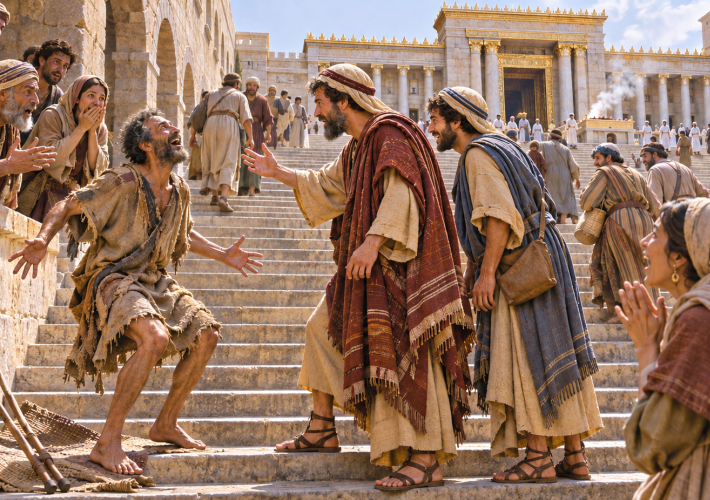
This corresponds with the ‘evening sacrifice’ which took place at about 3 PM every day6. Since the purpose of that sacrifice was to provide a way for the Hebrews to draw near to God, they prayed at that hour (as well as at 9 AM) every day and apparently continued to do so after Yeshua was crucified.
· The ‘Synagogue’ – It was Yeshua’s custom to attend the synagogue on the Shabbat7. He obviously did so as a way to follow the Torah command to participate in a ‘micra qodesh’ (holy convocation or assembly) as found in Leviticus 23:3. The Torah does not indicate where one is to assemble, it just says to assemble – and Yeshua chose to do so with all His Jewish countrymen. It was his ‘custom’
· Synagogue Structure - Not only did Yeshua attend the synagogue, He followed the synagogue structure which included the acknowledgment of the ‘leader of the synagogue’ 8
· Torah and Haftara Readings – As part of each Sabbath’s synagogue service, it was the custom to read a specific portion of the Torah as well as a specific portion from the prophets. Yeshua followed that custom9
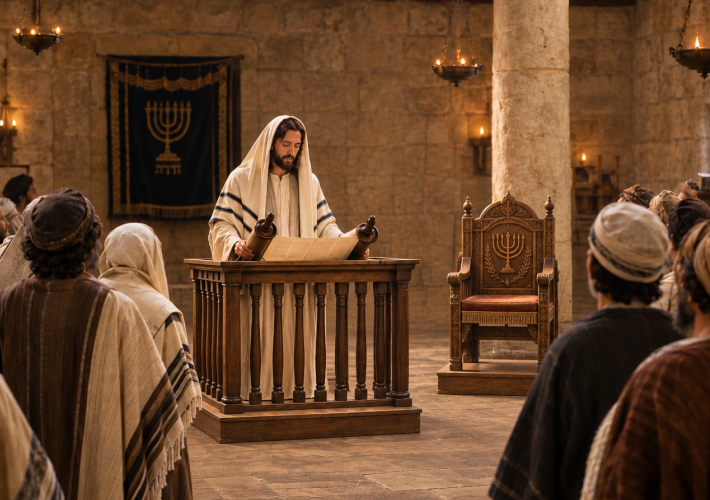
· Synagogue Protocol – It was the protocol for the teacher to stand when reading the Scriptures (Torah, Writings, Prophets) and then to sit when making commentary on them. This is more than likely a carryover from Moses who would sit when judging the people10. This is the basis of the traditional ‘Seat of Moses’ found in the synagogue11. Yeshua followed that protocol by standing when He read the words of the prophet Isaiah and by sitting when He made commentary on what He had read.
· ‘Rabbi / Disciple’ System - Yeshua was considered to be a ‘rabbi’ which is the Aramaic way of saying ‘teacher’12. The entire ‘Rabbi / Disciple’ system was a creation of the Pharisees. It came about as a result of the Hellenization of the Jews in the years that led to the Macabbean revolt (Hanukkah). The Pharisees (separatists) were those who were diligent for the Torah and the prophets and were opposed to the corrupt ‘pro-hellenist’ priesthood that eventually came from Mattathias ben Johanan’s (the father of the Macabbee’s) great grandson Judah Aristobulus I.
· Bar Mitzva – It was, and is, a Jewish tradition for a young man who turns 12-13 to become a ‘son of the Torah’ 13. Today, the tradition includes the boy being questioned by the rabbis is order to gauge his level of Torah understanding. Though it is not clear, it appears that Yeshua’s encounter with the rabbis was a result of Him turning to that age (Yeshua was born at about the time of the fall festivals).
· The “Last Great Day” – The Jews of the first century observed a special ‘Temple’ celebration called the called the ‘Beit haShuava’ (the ‘Water Pouring Ceremony’ every morning during the 7-day festival of Sukkot. This daily ceremony is nowhere mandated in the scripture – it is simply tradition. On the seventh or ‘last great day’ the festival, the ceremony was amplified. It was at the crescendo of the ceremony on that day that Yeshua made his proclamation “… If any man thirst, let him come unto me, and drink …” 14. That evening, Sukkot ended and everyone was able to move out of their sukkah and back into a house15. The next day was Shemini Atzoret – the Eighth Day Assembly.
· Moon sightings – The Pharisees, Sadducees, and the scribes made every effort to find fault with Yeshua, but were unable to do so. One thing they would have certainly criticized Him for would have been if he had chosen to observe the festivals on any day other than what was prescribed by the Jewish leadership. It is commonly understood that in the first century, the Jews counted the beginning of a month via a sighted moon (or a default siting if conditions were too cloudy to see the moon.) The Torah makes no statement as to how to determine the 1st day of the month, thus the determination was made by the judges using various traditions. Yeshua therefore, followed the established tradition. Note that it was some 200 years later that the fixed ‘Hallel’ calendar was established (which I subscribe to for various reasons).
· Hanukkah - (John 10:22) – Hanukkah is a Jewish tradition that celebrates the Jewish defeat of the Syrian army in Judea in the late 3rd century BCE. It is a man-made festival that Yeshua observed at least once, but likely observed all His life. John recorded this event in a somewhat ‘matter of fact’ way, but included the fact that He was in Jerusalem in the winter. Yeshua generally did not travel the 70 + miles from His home in Capernaum to Jerusalem except for the Biblical festivals – none of which are in winter. But He did choose to do so to observe Hanukkah.
· Buried in the ‘Custom of the Jews’ – the scriptures are somewhat vague in regards to Hebrew burial practices. Nevertheless, the text16 says that Yeshua was buried following Jewish burial traditions which include various washings, being wrapped in strips of cloth, and covered with a large amount of spices and herbs.
· Honored the Illegitimate Priesthood - Yeshua healed a leper17 and then reminded the man to show himself to the priest since only a priest could declare that a leper had been healed. He did so even though the priesthood was illegitimate and corrupt. There are many more examples of Yeshua recognizing the Sadducean priesthood of the day.
· Traditional Jewish Wedding - Yeshua was fully aware of the Jewish marriage customs, and in fact used a traditional Jewish wedding to perform His first public miracle18. A close study of the ancient Jewish wedding practices (some even dating back to Abraham’s day) show that the traditional Jewish (Hebrew) wedding closely aligns with the Biblical festivals of Lev. 23. Together, they show us God’s plan of salvation for all who are willing to follow His ways.
· Jewish Eschatology - Yeshua, the prophets, and the apostles made references to the ‘Last trumpet‘ and to the ‘Great trumpet’. These trumpets, the ‘first’, the ‘last’, and the ‘great’ trumpet are part of traditional Jewish eschatology and do not imply an order. Instead, the ‘first’ trumpet symbolizes shofar blast that was heard on Mount Sinai when Israel became betrothed to YHVH. The ‘last’ trumpet (Joel 2:1, 1 Cor. 15:52) is the one that is blown on Yom Teruah and marks the beginning of the ‘birth pains of the Messiah’, and the ‘great’ trumpet (Matt. 24:31) is blown on Yom Kippur and marks the time when YHVH will begin to draw His people back to their inheritance on Yom Kippur, the beginning of the Jubilee.
· The Temple Tax – this 1st century tax was not required by the Torah19. Instead it was an outgrowth of the one-time ½ shekel atonement money collected in order to count the Hebrew people20. It was then used in the service of the tabernacle. It was was never collected again throughout the Tnakh21. It crops up though in the 1st century as a way to pay the expenses of the Temple. A tax collector came to Peter and asked if his teacher (Yeshua) paid the temple tax. Yeshua replied that it was not necessary, but told Peter to collect the coins found in a fish’s mouth and pay the tax “in order to avoid offense”.
Based on these examples, it is pretty clear that Yeshua did not have a problem with all of the Jewish traditions. He only had problems with the traditions that were in opposition to the Torah and were imposed on the people as if they were Torah 22. An example of one that was in opposition to the Torah was the prohibition of Jews eating at the table with a Gentile (Matt. 9:10; Gal. 2:11-14), a Jewish tradition which Peter apparently continued to follow until his encounter with Cornelius23.
NKJ Acts 10:28 - Then he said to them, "You know how unlawful it is for a Jewish man to keep company with or go to one of another nation. But God has shown me that I should not call any man common or unclean.
Many of the traditions found in the NT came about as an effort to prevent assimilation of the Jews back into the Greek culture. After the days of Alexander, the Great, the Jews had a problem with assimilation as the younger people tended to mix more readily with their ‘Greek’ friends. The Maccabean war was an effort to drive Hellenism out of Judea, but it was not 100% effective. In fact, because so many Jews had adopted the Greek (Hellenistic) culture, the Septuagint – a Greek translation of the known scriptures up to that time, was written and subsequently came to be the predominate text of the NT writers24.
Other traditions, such as the ‘Sabbath day’s journey’ (Act 1:12), were ways to keep the Jews in check and promote attendance at the synagogue. In fact, the entire rabbinical system came about as a result of the Jewish people losing site of the Torah as did the northern tribes -
NKJ Hos. 4:6 - My people are destroyed for lack of knowledge. Because you have rejected knowledge, I also will reject you from being priest for Me; Because you have forgotten the law of your God, I also will forget your children.
The entire system was created to provide schools for the children, and a perpetual source of teachers (rabbis) who could teach the Torah. As mentioned earlier, Yeshua used this system to raise up disciples. He expected His disciples to do the same, but with the one caveat – they were not to come up with their own interpretation of scripture, they were only to use His interpretation (Matt. 23:8-10).
Though many focus on the Jewish tradition of ritual hand washing (Matt. 15:2, Mark 7:1), the Pharisees came up with it as a result of the original intent YHVH had for Israel which was that they were to become a kingdom of priests25. Since only the Levites came forward on God’s behalf at the ‘golden calf’ incident, the priesthood was transferred to the tribe of Levi. Nevertheless, the Pharisees taught that in the home, the father is in fact – a priest, and thus were to maintain some of the requirements given to the Levitical priesthood26. If they had kept their belief to themselves and did not attempt to impose it on others, it would have probably been OK.
It's clear that Yeshua, the disciples, and the apostles continued to follow many of the Jewish traditions of their day. Thus we can conclude that tradition is not necessarily bad – even if it’s Jewish tradition. In fact, without a good understanding of Jewish traditions, we could not understand the calling Yeshua left for us when He told His disciples to -
"Go therefore and make disciples of all the nations, baptizing them in the name of the Father and of the Son and of the Holy Spirit, 20 "teaching them to observe all things that I have commanded you; and lo, I am with you always, even to the end of the age." Amen.
NKJ Matt. 28:19-20
Shalom Aleichem
1 1 Corinthians 10:1-3 – in a metaphorical sense, Paul was showing that the Hebrews became part of the covenant through baptism, but later went into idolatry.
2 Hebrews 6:2
3 Matthew 3:6
4 Matthew 3:7; Luke 3:7
5 Acts 3:1 (KJV)
6 Numbers 28:1-8; these ‘sacrifices’ were a way for the Hebrew people to ‘draw near’ to God which is what the word ‘qorban’ (7133) which comes from the word ‘qarab’ (7126) really means
7 Luke 4:16
8 Mark 5:36 – in regards to Jarius’ daughter
9 Luke 4:16-21; Acts 13:15, 27
10 Exodus 18:13
11 Matt. 23:11
12 Matt. 26:25, Mark 9:5, Mark 11:21, John 1:38, John 1:49, John 3:2, John 4:31, John 6:25, John 9:2, John 11:8
13 Luke 2:42
14 John 7:37-40 – Sukkot (Feast of Booths) is a 7-day festival, and therefore the last day of the festival is the seventh day. Sukkot is immediately followed by another festival called ‘Shemini Atzoreth’.
15 Lev. 23:42
16 John 19:38
17 Luke 5:7-14
18 John 2:1
19 Matt. 17:24-27 – there is a question as to whether this was a tax imposed by the Jews or by the Romans. In either case, Yeshua was not required to pay it. Nevertheless, He paid it in order to avoid ‘offense’, i.e.- creating a scandal.
20 Exodus 30:11-16 – instead of counting people, they counted money.
21 It was resurrected for a short time in Judea during Nehemiah’s governorship as a 1/3 shekel
22 YHVH specifically prohibits ‘adding to’ or ‘taking from’ the Torah (Deut. 4:2; 12:32)
23 The word ‘nation’ in this passage actually means ‘tribe’.
See
https://www.amiyisrael.org/articles/Cornelius/Cornelius.htm
24 In fact, the majority of NT quotations from the OT were from the Septuagint, not the so-called ‘original Hebrew’.
25 Exodus 19:6
26 Exodus 30:17-21; Ps. 26:1-6