


Birth of the Messiah
When was Jesus REALLY Born
by: Tim Kelley
December 20, 2025

God literally coming to Earth and 'dwelling' with His people is the fulfillment of God's greatest prophecy. Yet Christians throughout the world honor this event nowhere near when the event actually happened. With the timing of Jesus' birth so easy to figure out, why is that the case?
When was Jesus born? Did God leave us clueless to the timing of one of the greatest events in world history—the coming of the Light of the World? Can we determine from the pages of our Bible the season and approximate date that Jesus was born?
The apostle Paul wrote that –
NKJ 2 Tim. 3:16-17 - All Scripture is given by inspiration of God, and is profitable for doctrine, for reproof, for correction, for instruction in righteousness, 17 that the man of God may be complete, thoroughly equipped for every good work.
All the scriptures have a purpose, but sometimes that purpose is hidden in the fine points of scripture – points that are sometimes overlooked as we read through the text. Therefore, we have to search through the text for that purpose, which is exactly what King Solomon stated some 3000 years ago –
NKJ Prov. 25:2 - It is the glory of God to conceal a matter, But the glory of kings is to search out a matter.
So let’s read the pertinent Biblical narratives of Yeshua’s birth, and pick up the finer points so that we might be able to determined when Jesus was actually born. We’ll start in Matthew –
NKJ Matt. 1:18-23 - Now the birth of Jesus Christ was as follows: After His mother Mary was betrothed to Joseph, before they came together, she was found with child of the Holy Spirit. 19 Then Joseph her husband, being a just man, and not wanting to make her a public example, was minded to put her away secretly. 20 But while he thought about these things, behold, an angel of the Lord appeared to him in a dream, saying, "Joseph, son of David, do not be afraid to take to you Mary your wife, for that which is conceived in her is of the Holy Spirit. 21 "And she will bring forth a Son, and you shall call His name JESUS, for He will save His people from their sins." 22 So all this was done that it might be fulfilled which was spoken by the Lord through the prophet, saying: 23 "Behold, the virgin shall be with child, and bear a Son, and they shall call His name Immanuel," which is translated, "God with us."
This is where we first begin to see the fulfillment of a number of ‘Messianic’ prophecies. We learn that Joseph - Jesus’ ‘step-father’ - was a descendant of King David, and would be a legitimate heir to the throne of Israel if David’s dynasty had continued – which of course, it did not.
We also learn that the baby would be conceived of the ‘Holy Spirit’, thus Joseph had no involvement in the conception of the child, and finally, we see that the child would be the fulfillment of the Isaiah 7 prophecy of the ‘virgin birth’.
Continuing in Matthew, we will pick up more points –
NKJ Matt. 2:1-3 - Now after Jesus was born in Bethlehem of Judea in the days of Herod the king, behold, wise men from the East came to Jerusalem, 2 saying, "Where is He who has been born King of the Jews? For we have seen His star in the East and have come to worship Him." 3 When Herod the king heard this, he was troubled, and all Jerusalem with him.
This, of course, is the passage where Herod commanded that all Jewish boys 2 years old or younger were to be put to death. Apparently, Herod had heard about Jesus from the ‘wise men’ who had probably told him that the prophesied Messiah had indeed been born and that a bright star seemed to be leading them to him.
It is also apparent that they revealed information from which Herod concluded that the child was between one and two years old. How do we know He was no longer and infant? We know because in the manger story (Luke 2:12), Jesus is called a ‘babe’ (Greek ‘brephos’ Strong’s 1025) which means anything from an ‘embryo’ to an ‘infant’, but in the Matthew 2 story, He is called a ‘paidion’ (Strong’s 3813) which is used to indicate a ‘young child.’ In fact the term ‘paidion’ is also applied to Jarius’ daughter who we know to be twelve years old (Mark 5:39).
Let’s read on -
NKJ Matt. 2:13-15 - Now when they had departed, behold, an angel of the Lord appeared to Joseph in a dream, saying, "Arise, take the young Child and His mother, flee to Egypt, and stay there until I bring you word; for Herod will seek the young Child to destroy Him." 14 When he arose, he took the young Child and His mother by night and departed for Egypt, 15 and was there until the death of Herod, that it might be fulfilled which was spoken by the Lord through the prophet, saying, "Out of Egypt I called My Son“.
Determined that a new ‘king’ was not going to undermine his dynasty, Herod was determined to kill the child. So, after the wise man had departed, he made the edict that all the Jewish boys, two years old or younger, were to be put to death. Thus Yeshua’s parents – who had returned to their home in Nazareth – were instructed to flee to Egypt in order to escape the edict. We do not know how long they stayed in Egypt, but we do know they stayed until they got word that Herod was dead and that it was safe to return to Nazareth.
If we could determine which ‘Herod’1 made the edict, we could pretty much determine what year Jesus was born. Thankfully we do have a clue, and it’s found in Matthew 2 where it says -
NKJ Matt. 2:19-22 - But when Herod was dead, behold, an angel of the Lord appeared in a dream to Joseph in Egypt, 20 saying, "Arise, take the young Child and His mother, and go to the land of Israel, for those who sought the young Child's life are dead." 21 Then he arose, took the young Child and His mother, and came into the land of Israel. 22 But when he heard that Archelaus was reigning over Judea instead of his father Herod, he was afraid to go there. And being warned by God in a dream, he turned aside into the region of Galilee.
Matthew records that Herod died and was replaced by (Herod) Archelaus. History points out that Archelaus was the son of Herod the Great who died in 4 BCE.
With this information, we can be confident that Jesus was born at around 6 BCE about 2 years before the death of Herod. But what time of year was Jesus born? By digging into the scripture, we can come up with a close approximation of that as well – maybe even to within a week or two. To do so, we must find a definite point in time located somewhere in the Biblical narrative that will give us a place to start. We find that point in the story of the birth of John the Baptist –
NKJ Luke1:5 - There was in the days of Herod, the king of Judea, a certain priest named Zacharias, of the division of Abijah. His wife was of the daughters of Aaron, and her name was Elizabeth.
This – of course – is the narrative leading up to the birth of John the Baptist. Luke points out that the event he was writing about took place during the time of Herod’s reign, and we have already seen that the ‘Herod’ mentioned here was Herod the Great.
We also find that both Zacharias and his wife Elizebeth were descendants of priests. What’s more, we see that Zachariah – though an old man - was still an active priest. But the point that is relevant to our discussion is that Zacharias was ‘of the division of Abijah’.
What does ‘of the division of Abijah’ mean? Without an understanding of the Biblical priesthood, many would pass over this little bit of information and thus miss a critical point. Let’s find out what this ‘division of Abijah’ is all about. To do so we must go back to the time of King David as he was preparing to turn the Kingdom over to his son Solomon -
NKJ 1 Chron. 24:1-5 - Now these are the divisions of the sons of Aaron … 3 … David with Zadok of the sons of Eleazar, and Ahimelech of the sons of Ithamar, divided them according to the schedule of their service … 5 … they were divided by lot, one group as another, … 6 and the scribe, Shemaiah … wrote them down before the King …
As King David was nearing the end of his life and as he was preparing for the building of the Temple, he realized that because there were so many priests, they could not effectively serve all at one time in the new Temple. He consulted with the two ‘high priests’ - Zadok and Ahimelech - and together they decided to divide the priests into twenty-four ‘divisions’ based on the number of the leaders of the sons of Aaron These ‘divisions’2 would all serve according to a set schedule. That schedule was based on the casting of lots.
Reading on, we find the order of that schedule –
NKJ 1 Chron. 24:7-19 - Now the first lot fell to Jehoiarib, the second to Jedaiah, 8 the third to Harim, the fourth to Seorim, 9 the fifth to Malchijah, the sixth to Mijamin, 10 the seventh to Hakkoz, the eighth to Abijah, 11 the ninth to Jeshua, the tenth to Shecaniah, 12 the eleventh to Eliashib, the twelfth to Jakim, 13 the thirteenth to Huppah, the fourteenth to Jeshebeab, 14 the fifteenth to Bilgah, the sixteenth to Immer, 15 the seventeenth to Hezir, the eighteenth to Happizzez, 16 the nineteenth to Pethahiah, the twentieth to Jehezekel, 17 the twenty-first to Jachin, the twenty-second to Gamul, 18 the twenty-third to Delaiah, the twenty-fourth to Maaziah. 19 This was the schedule of their service for coming into the house of the LORD according to their ordinance by the hand of Aaron their father, as the LORD God of Israel had commanded him.
So we see that according to the schedule, the division of Abijah was the eighth to serve. What we do not see is how long they served. Did they serve for a day? For a month? The scripture is not clear. But a little clarity is provided by the historian Flavious Josephus3 who wrote during the latter part of the first century CE. Josephus writes -
“… 365 He divided them also into courses: and when he had separated the priests from them, he found of these priests twenty-four courses, sixteen of the house of Eleazar, and eight of that of Ithamar; and he ordained that one course should minister to God eight days, from Sabbath to Sabbath. 366 And thus were the courses distributed by lot, in the presence of David, and Zadok and Abiathar the high priests, and of all the rulers; and that course which came up first was written down as the first, and accordingly the second, and so on to the twenty-fourth; and this partition hath remained to this day.
What we find is that they served eight consecutive days beginning on the weekly Sabbath and ending on the next weekly Sabbath. In other words, their service overlapped. This overlap may have been due to the fact that the sacrifices (morning and evening) were doubled on the Sabbath, but more than likely, it was due to the oral tradition that a person could walk no more than a ‘Sabbath’s day journey’ (Acts 1:12) on the Sabbath. Therefore, they might as well continue to serve on the Sabbath, then begin their travel home the next day. So we can assume that the priests would arrive before sundown on the 6th day (Friday) and not leave for home until the next morning.
Just to make sure this practice was in place during Zachariah’s day – Josephus states that this tradition was still in effect during his day, some 90 – 100 years after the Biblical narrative.
A little more information can be found in Jewish sources4. The Mishnah is a collection of Jewish oral traditions. It was compiled around 200 CE (200 AD). In it we find this information concerning the priests:
“At three times during the year, all twenty-four priestly watches have equal status, in that all receive a share in the Temple service independent of the standard order of the watches and all receive a share in the accompanying gifts of the priesthood …”
From this, we see that during the yearly festivals – Passover, Shavuot, Yom Teruah, Yom Kippur, and Sukkot - all 24 divisions served – presumably because of all the sacrifices and the influx of people from throughout Judea-Samaria and the surrounding nations (see Acts 2). These people would bring their own sacrifices, tithes, and offerings, and the work associated with these took place at the Temple by the priests and the Levites.
Because there were only 24 divisions, and each division served for one week, it is understood that there must have two cycles per year with the first cycle being 26-27 weeks long (based on how Passover fell within the week), and the second cycle being up to 28 weeks (based on how the fall festival’s fell (the priests may not have gathered on Yom Kippur because the additional sacrifices were carried out by the High Priest). The first cycle would start at the beginning of the year in the month of Nisan, and end near the middle of the month of Tishri (fall festival season). The next cycle would start after Sukkot.
With that understanding of the divisions of the priests, let’s continue with Lukes’s narrative of John’s birth –
NKJ Luke 1:23-31 - And so it was, as soon as the days of his service were completed, that he departed to his own house. 24 Now after those days his wife Elizabeth conceived; and she hid herself five months …, 26 Now in the sixth month the angel Gabriel was sent by God to a city of Galilee named Nazareth, 27 to a virgin betrothed to a man whose name was Joseph, of the house of David. The virgin's name was Mary. 28 And having come in, the angel said to her, "Rejoice, highly favored one, the Lord is with you; blessed are you among women!" 29 But when she saw him, she was troubled at his saying, and considered what manner of greeting this was. 30 Then the angel said to her, "Do not be afraid, Mary, for you have found favor with God. 31 "And behold, you will conceive in your womb and bring forth a Son, and shall call His name JESUS.
Zechariah was surely ecstatic! He had been wanting a son for so long, and now he was going to have one. He continued to serve the remainder of the week, then made his way home the next Sunday morning, and it is likely that Elizebeth conceived that evening or maybe a few days later.
The narrative then changes to the birth of Jesus with the angel Gabriel – during the sixth month of Elizabeths' pregnancy - announcing to Mary that she ‘will’ conceive a son. The text states that “in the sixth month of Elizabeth’s pregnancy, the angel Gabriel came to Mary saying …” It appears Gabriel is stating that she will in the future conceive a son, but it does not state how far into the future it will take place. Because her conception was via the Holy Spirit and not dependent on a man, it could happen any time ‘in the future’. It could happen as soon as the angel left. It could happen right then!
Reading on we see that it did happen soon thereafter –
NKJ Luke 1:34-37 - Then Mary said to the angel, "How can this be, since I do not know a man?" 35 And the angel answered and said to her, "The Holy Spirit will come upon you, and the power of the Highest will overshadow you; therefore, also, that Holy One who is to be born will be called the Son of God. 36 "Now indeed, Elizabeth your relative has also conceived a son in her old age; and this is now the sixth month for her who was called barren. 37 "For with God nothing will be impossible."
Gabriel seems to indicate that within the moment that he announced that she ‘would’ conceive, she was indeed impregnated by the Holy Spirit, and now she is in the same state as her relative Elizabeth who had ‘also’ conceived. This is very similar to the story of Abraham and Sarah who thought it impossible to be pregnant, but who apparently was already pregnant (Gen. 18:14).
Surprised that Elizebeth – her aged relative – was pregnant, Mary decided to pay her a visit.
NKJ Luke 1:39-44 - Now Mary arose in those days and went into the hill country with haste, to a city of Judah, 40 and entered the house of Zacharias and greeted Elizabeth. 41 And it happened, when Elizabeth heard the greeting of Mary, that the babe leaped in her womb; and Elizabeth was filled with the Holy Spirit. 42 Then she spoke out with a loud voice and said, "Blessed are you among women, and blessed is the fruit of your womb! 43 "But why is this granted to me, that the mother of my Lord should come to me? 44 "For indeed, as soon as the voice of your greeting sounded in my ears, the babe leaped in my womb for joy.
Based on Luke’s narrative (Luke 1:26), Mary lived in Nazareth which is in the area of the Sea of Galilee (traditionally west of modern Tiberius) and went to Elizabeth’s home located in the ‘hill country of Judah’. This would have been an arduous 70+ mile journey through mountainous terrain. Nevertheless, Mary made the journey even though she was pregnant - as attested by the fact that even John – 6 months after being conceived – recognized the presence of the newly conceived child in Mary’s womb.
According to the text, Mary stayed with Elizabeth until John was born (Luke 1:56-57). She may have stayed that long because she wanted to be present when Elizebeth delivered her son. It could also be because she did not want to return to Nazareth in the middle of the rainy season.
With that, we have all the available information pertaining to the birth of John the Baptist and Jesus. Let’s now chart out that information and see what we come up with.
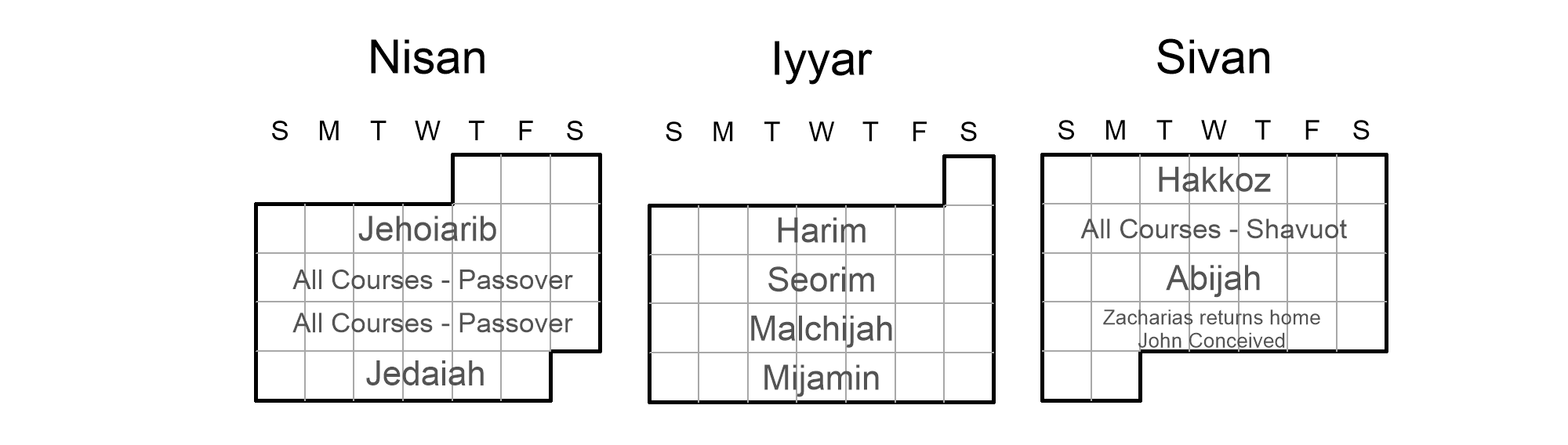
Hebrew months begin in the spring, and they are based on the sighting of the New Moon. Though it might seem somewhat simple to determines on what day the moon was ‘sighted’ and the month officially ‘declared’, it is not that simple since a number of factors play in. For instance - if the sky was obscured by clouds and no sliver of the moon could be seen, the New Month is postponed for up to two days. If the sighting took place from the east of rising terrain, the new month would start later since the horizon would be higher. These are just a couple of examples. Therefore, even if we knew the precise year, we would not be able to determine the exact day any specific month began. Therefore, the ‘calendar’ charts pictured here are at best – speculative. Therefore, I chose to start on a Thursday with a 30-day month, then continued with a 29 day – 30 day sequence of months which closely matches the lunar cycle. Based on my ‘months’, the first week of priestly service started with the division of Jehoiarib. As mentioned before, the divisions always started on the Sabbath of the prior week, and finished on the Sabbath of the current week. On this calendar, it would have been Nisan 3-10, and according to the scripture, the 10th day of Nisan is when the Hebrew families were to choose a lamb for the Passover (Exodus 12:3). Thursday of the next week would have been Passover, and the festival would have continued through the next Wednesday. Therefore, all 24 divisions would have served during those two weeks.
The following week, the course of Jedaiah would have served, followed by divisions 3-5. The division that worked the first week of Sivan would be based on how a person interprets the instructions pertaining to the wave sheaf offering (Lev. 23:9-16). Since the Sadducees believed the wave-sheaf offering took place on a Sunday, and since they controlled the Temple during that period of history, I chose to place Shavuot during the second week of Sivan instead of earlier as it would have been by using the Pharisee’s way of counting. Thus the 7th division served the first week of Sivan, and all the divisions worked the second week5.
Abijah’s service began on the Sabbath of the 14th and continued through the Sabbath of the 21. We know that Zacharias remained at the Temple until the service of his (Abijah’s) division was complete, so he did not begin his journey home until the 4th week. I would assume that since he had such good news to share with his wife, he did not tarry, but made his way home as quick as possible.
The city in which he lived is not named – we are only told that he and Elizebeth lived in ‘the hill country of Judea’ (Luke 1:39, 65) which many believe to be somewhere just west of Jerusalem – probably not more than 1 or 2 day’s walk. Therefore, it’s quite likely John was conceive during the 4th week of the month of Sivan. With the 4th week of Sivan as a marker, let’s begin to count the weeks.
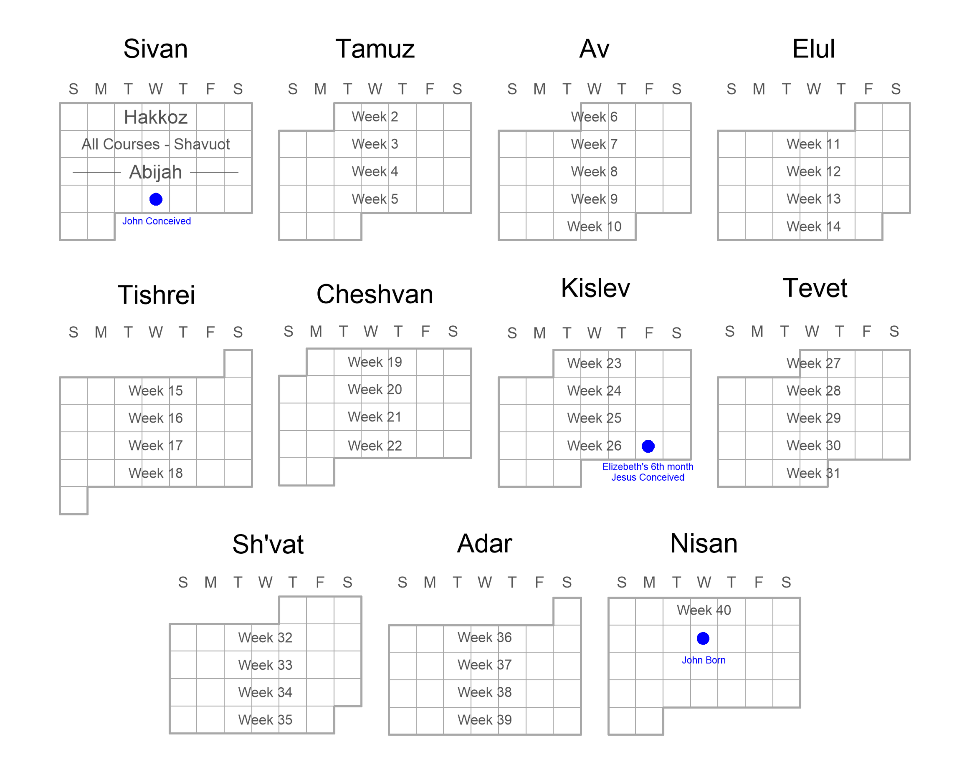
Being that Luke was writing before the Gregorian calendar was designed, we can safely assume that his reference to ‘months’ would be according to the Jewish ‘lunar’ calendar. Because lunar months are shorter than Gregorian months, I used his reference to ‘months’ as a particular day in the month without respect to the ‘number of days in a month. Therefore, if John was conceived on the 24th day of Sivan, the ‘6th’ month would conclude accordingly on the 24th day of Keslev which is one day before Hanukkah. Continuing to full term – 40 weeks – we find that John was born early In the second week of Nisan – just a few days before Passover, and quite close to Nisan 10 - the day the Hebrews were to pick a lamb for the Passover sacrifice.
The rest is quite simple, but we’ll chart it anyway –

We know that Elizebeth had been pregnant for 6 months when Mary conceived Jesus, and the six months ended on, or just prior to, Hanukkah6, so if we count weeks7, we find the end of the 40th week falling near the end of the second week of ‘Tishri’ which is near Yom Kippur (Tishri 10), which just happens to be the prophesied day of the Messiah’s return8. This is a littler clearer when looking at a timeline.
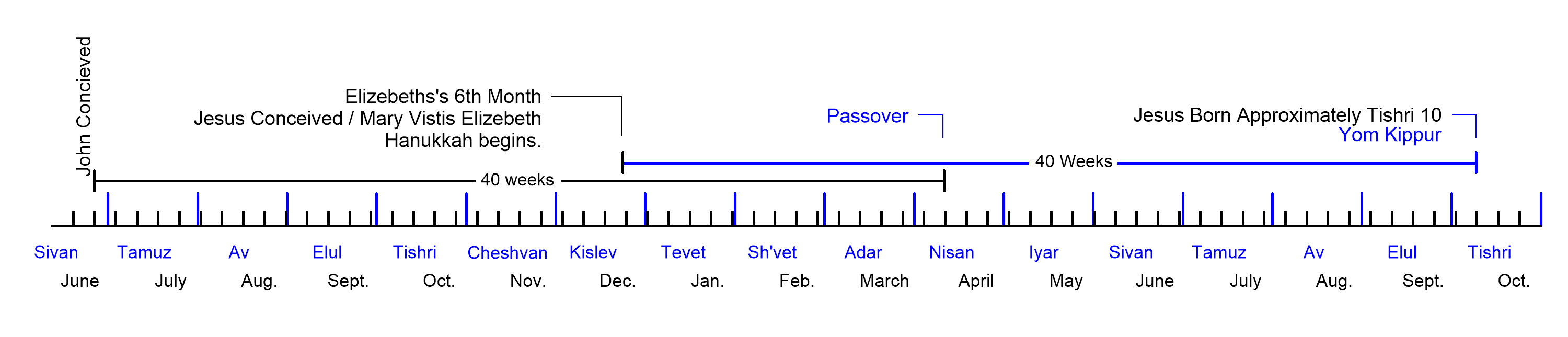
The timeline begins within the 3rd month - the month John the Baptist was conceived. We see the six-month point when Mary conceived, and shortly after that is when John ‘leaped’ in Elizebeth’s womb when Mary - carrying Jesus in her womb – approached Elizebeth in her home. The Gregorian calendar months are included so you can get a better picture of how this fits into our modern-day concept of months.
As before, the 6-month point is near the end of the month ‘Kislev” which is the beginning of Hanukkah. John’s birth coincides with the Passover season, and Yeshua’s birth corresponds with Yom Kippur and the fall festival of Sukkot.
By plotting out the accounts of Matthew and Luke on a chart or timeline, it’s clear to see when these events took place.
So here’s what we’ve seen –
- Jesus was born around 5 BC , a year or so before Herod the Great died.
- John was conceived soon after Zacharias served in his division - the latter part of the 3rd month which is called ‘Sivan’
- John was born early in the month of Nisan – around Passover
- Jesus was 6 months younger than John
- Jesus was born in the month of Tishri – probably on Yom Kippur
So the answer to the opening question - "Can we figure out the approximate time of Jesus' birth" is 'YES', and the interesting point is that it is not too hard to figure out. So why have Christian scholars not been able to see this? Or if they have seen it, why are they not telling their congregations? I submit the reason is that they know how deeply entrenched most Christians are to those holidays, and that by revealing the truth, they themselves would be considered to be ‘blind guides’ at best, or maybe even ‘false prophets’ for letting it go on for so long.
The truth is – God’s plan for the redemption and ultimate salvation of His people is in many ways dependent on the Biblical festivals of Leviticus 23. God did – and still does – work within His festivals. We should know that because He inspired the prophet Malachi to say -
"For I am the LORD, I do not change. Therefore, you are not consumed, O sons of Jacob.
NKJ Malachi 3:6
Shalom Aleichem!
1 ‘Herod’ is a title, not a name
2 The ‘divisions’ are referred to as ‘courses’ in Acts 13:22
3 Josephus - Antiquities of the Jews, 7.365-366 - https://lexundria.com/j_aj/7.365/wst
4 Mishnah Sukkah 5, Paragraph 7 - https://www.sefaria.org/Mishnah_Sukkah.5.7?lang=en
5 Note that the timing of Shavuot makes no difference in regards to the week of Abijah’s service because the 1st and 2nd weeks of service would have been switched.
6 I believe YHVH times events to correspond with important days on His calendar
7 A ‘normal’ pregnancy is 40 weeks.
8 See my article 'Yom Kippur - Jubilee'